The Role of APIs in Modern Document Workflows
Ten years ago, “document workflow” meant printing a file, walking it to a manager’s desk for a signature, scanning it, and emailing it to a client.
Today, workflows are digital, but often fragmented. Data lives in Salesforce. Contracts live in Dropbox. Signatures happen in DocuSign.
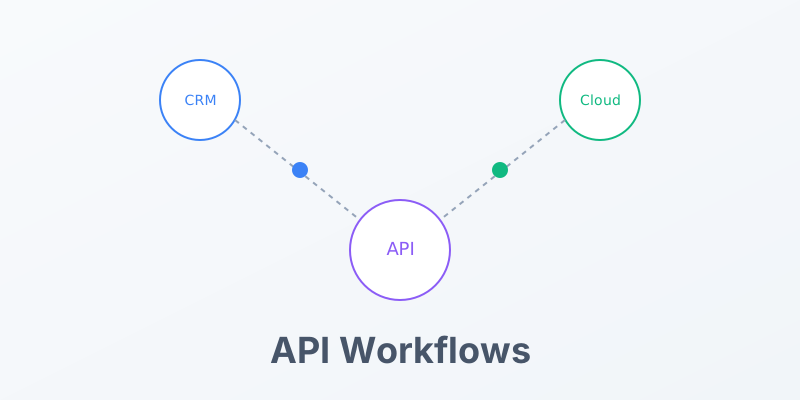
Application Programming Interfaces (APIs) are the invisible bridges that connect these islands. They allow different software systems to talk to each other, enabling a seamless flow of data into documents and back again.
1. What is a Document API?
A Document API is a set of protocols that allows an application to programmatically create, edit, or manage documents. Instead of a human clicking “File > Save As,” a computer sends a command: POST /api/generate-pdf.
This abstraction allows developers to build document capabilities into their own apps without reinventing the wheel.
2. The “Trigger-Action” Model
Modern workflows rely on triggers.
- Trigger: A customer purchases a plan on your website (Stripe API).
- Action: Your server calls a Document API to generate a receipt.
- Action: Your server calls an Email API (SendGrid) to send the receipt.
This entire chain happens in milliseconds, without human intervention. The API acts as the specialized worker that performs the specific task of “making the PDF” perfectly every time.
3. Decoupling Logic from Presentation
In legacy systems, the code to generate a PDF was often mixed in with the business logic. This meant that changing a font size required a code deployment.
APIs encourage decoupling. The business logic (calculating the price) lives in your app. The presentation logic (how the invoice looks) lives in the Document API’s template system. This separation of concerns makes systems more robust and easier to maintain.
4. Enabling “Headless” Operations
We are moving toward “headless” commerce and operations, where the backend processing is separated from the frontend experience.
A Document API allows you to generate documents in the background. You can generate a monthly report at 2 AM while your users are asleep, store it in the cloud, and send a push notification when they wake up. The document creation becomes a utility, like electricity, that is always available on demand.
5. The Ecosystem Effect
The real power comes when APIs are chained together.
- Data API (Salesforce) provides the customer info.
- Document API (MergeCanvas) generates the contract.
- Signature API (DocuSign) collects the signature.
- Storage API (Box) archives the final file.
This “best-of-breed” approach allows businesses to build custom, enterprise-grade workflows using specialized tools for each step, rather than relying on a single, clunky monolithic software suite.
Conclusion
APIs have transformed documents from static files into dynamic, programmable assets. By leveraging Document APIs, businesses can build workflows that are faster, more reliable, and infinitely scalable.
Connect your systems. MergeCanvas offers a developer-friendly API designed to integrate seamlessly into your modern tech stack.